In-Depth Review of TX3 Funding
In recent years, the proprietary trading (“prop firm”) industry has grown rapidly, offering retail traders the opportunity to manage large amounts of capital without risking significant personal funds. One of the firms that has entered this competitive space is TX3 Funding. Marketed as a fast-track funding solution for Forex and Futures traders, TX3 Funding promises quick evaluations, competitive profit splits, and scalable trading accounts.
This review provides a detailed and balanced analysis of TX3 Funding — how it works, what it offers, its strengths, weaknesses, risks, and whether it may be suitable for aspiring traders.
1. Overview of TX3 Funding
TX3 Funding positions itself as a proprietary trading firm that provides capital to skilled traders. Rather than requiring traders to deposit large amounts of their own money, the firm offers a structured evaluation process. If traders demonstrate profitability and disciplined risk management, they can gain access to a funded trading account.
The company primarily focuses on:
-
Forex trading
-
Futures trading
-
Evaluation-based funding programs
-
Profit-sharing arrangements
The central promise is simple:
Pass the evaluation → Receive funding → Earn profit splits.
Like many prop firms, TX3 Funding generates revenue through challenge fees rather than direct brokerage commissions.

2. How the TX3 Funding Model Works
Understanding the prop firm model is critical before evaluating TX3 Funding specifically.
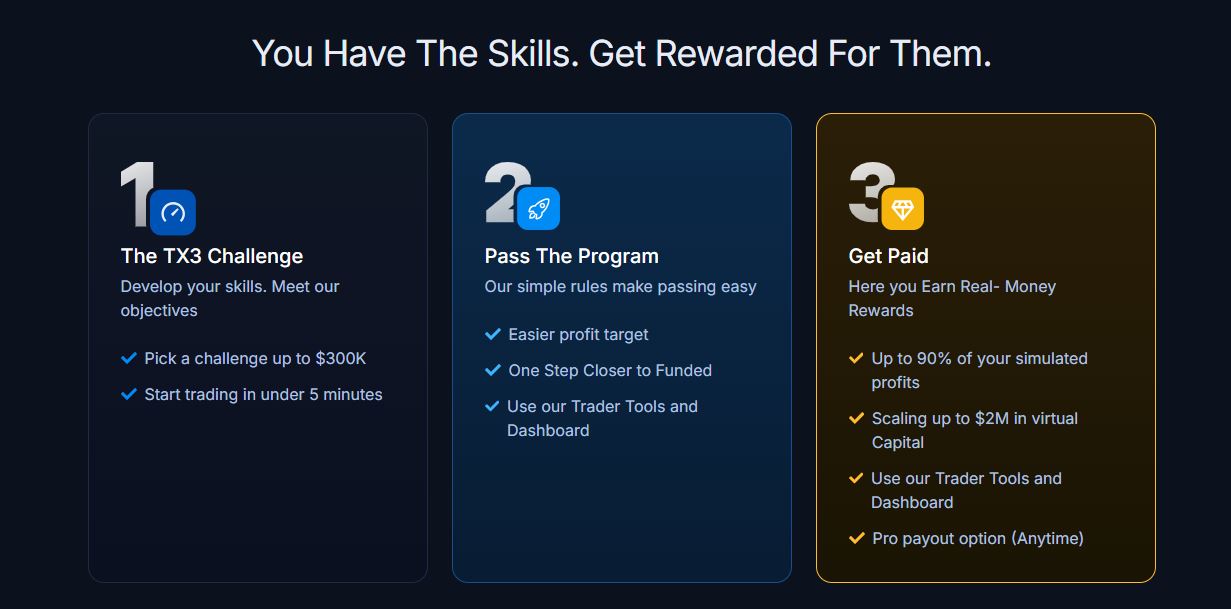
Step 1: Choose a Challenge
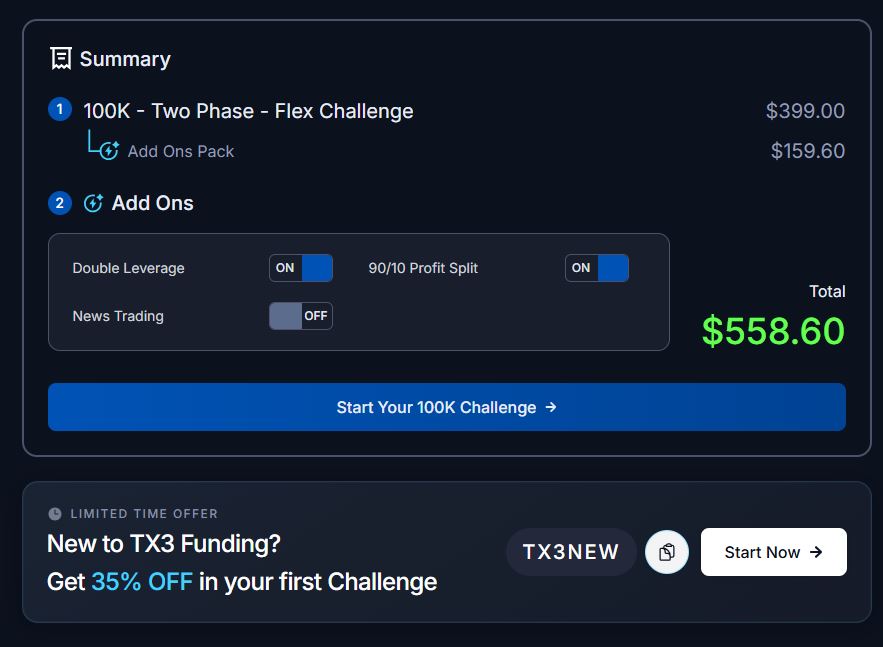
Traders select a funding challenge based on account size. These may range from smaller accounts (e.g., $10,000) to significantly larger simulated balances (e.g., $100,000+).
Each challenge includes:
-
A profit target (e.g., 8–10%)
-
Maximum daily drawdown limits
-
Maximum overall drawdown limits
-
Trading consistency rules
-
Minimum trading days
The trader pays a fee upfront to participate.
Step 2: Pass the Evaluation
To qualify for funding, traders must:
-
Reach the profit target
-
Avoid violating risk rules
-
Trade within the specified time frame (if any)
Some firms use one-step evaluations, others use two-step processes. TX3 Funding has offered variations depending on the product type (Forex vs Futures).
Step 3: Funded Account
Upon successful completion of the challenge:
-
The trader receives access to a funded account.
-
Profits are split between the trader and the firm.
-
Profit split ratios can reach competitive levels (often 80%–95%, depending on the plan).
3. Key Features of TX3 Funding
3.1 Account Sizes
TX3 Funding advertises multiple account tiers. These tiers allow traders to choose based on their confidence level and budget.
Typical structure includes:
-
Smaller entry-level accounts
-
Mid-tier professional accounts
-
Larger capital scaling accounts
Larger accounts generally require higher challenge fees.
3.2 Profit Split
One of the more attractive marketing points is the high profit split.
In many cases:
-
Initial splits may start around 80%
-
Some programs claim up to 90–95%
A high profit split is competitive in the prop industry. However, traders must carefully review whether scaling conditions or withdrawal limitations apply.
3.3 Scaling Plan
Many prop firms allow traders to increase capital allocation over time if they consistently generate profits without breaching risk rules.
TX3 Funding promotes capital growth opportunities, although the specific scaling milestones should be reviewed carefully in the official terms.
3.4 Platform & Instruments
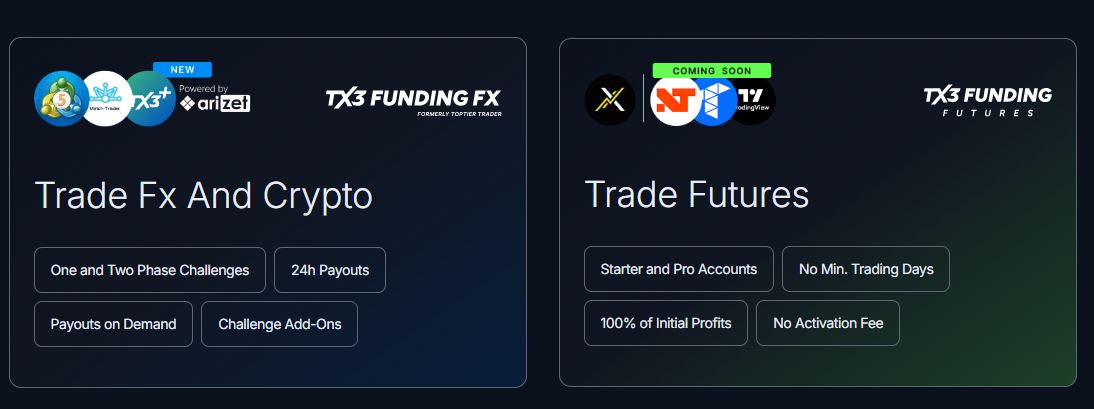
The firm supports:
-
Forex pairs
-
Major Futures contracts
The trading platforms available depend on the program selected. Traders should verify execution conditions, spreads, slippage policies, and whether trading is simulated or connected to live liquidity providers.
4. Advantages of TX3 Funding
4.1 Access to Capital
For many traders, the biggest benefit is psychological and financial leverage. Instead of risking personal savings, traders pay a fixed evaluation fee.
If successful, they can:
-
Trade larger capital
-
Keep a significant share of profits
-
Build track records
4.2 Defined Risk Structure
The challenge model enforces discipline:
-
Strict drawdown limits
-
Risk management requirements
-
Performance consistency rules
While restrictive, these rules can help traders develop structured habits.
4.3 Potentially Fast Funding
TX3 Funding markets itself as a fast-track solution. Depending on the program, traders may complete evaluation steps relatively quickly compared to firms requiring extended trading periods.
4.4 High Advertised Profit Split
A 90%+ split is attractive compared to traditional prop firms that may offer 50–70%.
However, traders should confirm:
-
Whether the split applies immediately
-
If minimum withdrawal thresholds exist
-
If payout delays are possible
5. Risks and Concerns
No prop firm is risk-free. TX3 Funding is no exception.
5.1 Evaluation Failure Risk
Most traders fail evaluation challenges.
Reasons include:
-
Emotional trading
-
Overleveraging
-
Underestimating drawdown limits
-
Inconsistent strategy performance
Challenge fees are typically non-refundable if you fail.
5.2 Rule Violations
Prop firms often include strict rules such as:
-
No news trading
-
No arbitrage
-
No high-frequency bots (depending on policy)
-
Daily loss caps
Even profitable traders can lose accounts if they break rules unintentionally.
5.3 Transparency & Regulatory Status
One important consideration is regulatory oversight.
Prop firms typically:
-
Are not traditional brokers
-
Are not regulated like banks or investment firms
-
Operate using simulated trading environments
Traders must understand that this industry operates in a gray regulatory zone. Always verify company registration, terms, and legal disclosures before paying fees.
5.4 Mixed User Reviews
Online reviews for prop firms tend to be polarized.
Common positive feedback themes:
-
Fast payouts
-
Helpful customer support
-
Smooth challenge process
Common negative feedback themes:
-
Account disqualifications
-
Delayed withdrawals
-
Confusion over rule interpretation
Such mixed reviews are common in the prop trading space and should be interpreted cautiously.
6. Comparison With Other Prop Firms
When comparing TX3 Funding with competitors, traders often consider:
-
Profit split percentage
-
Evaluation difficulty
-
Maximum drawdown structure
-
Payout frequency
-
Transparency
-
Longevity of the firm
TX3 Funding appears competitive in terms of profit splits, but traders should compare detailed rule structures carefully before committing.
Start Your Professional Trading Journey
7. Is TX3 Funding Legit or a Scam?
This is a common question.
Important distinction:
A prop firm charging evaluation fees is not automatically a scam. The entire business model depends on evaluation revenue.
However, traders should check:
-
Company registration
-
Clear terms & conditions
-
Transparent payout policies
-
Active customer support
-
Verified payment proofs (with caution)
No firm can guarantee profits. If marketing promises “easy money,” that should be viewed skeptically.
8. Who Is TX3 Funding Suitable For?
TX3 Funding may be suitable for:
-
Experienced traders with proven strategies
-
Disciplined risk managers
-
Traders comfortable with strict rules
-
Those seeking capital leverage without risking large personal funds
It may not be suitable for:
-
Complete beginners
-
Emotional or impulsive traders
-
Individuals expecting guaranteed income
-
Traders unwilling to follow structured rules
9. Psychological Considerations
The evaluation model adds psychological pressure:
-
Time constraints
-
Daily drawdown caps
-
Performance targets
This can cause:
-
Overtrading
-
Revenge trading
-
Forced setups
Traders should test strategies extensively on demo accounts before attempting paid challenges.
10. Financial Considerations
Before joining:
-
Only use disposable income for challenge fees.
-
Do not borrow money to fund evaluation attempts.
-
Consider the statistical probability of passing.
-
Treat evaluation fees as business expenses, not investments.
Remember: funding is not guaranteed income.
11. Red Flags to Watch For
Regardless of firm, look out for:
-
Unrealistic promises
-
Lack of clear legal documentation
-
Vague ownership details
-
Aggressive marketing tactics
-
Influencer-only promotion without transparency
Always read the fine print.
12. Final Verdict
TX3 Funding represents a modern proprietary trading opportunity within a rapidly growing industry.
Strengths:
-
Competitive profit splits
-
Structured funding pathway
-
Access to Forex & Futures markets
-
Capital scaling potential
Weaknesses:
-
Evaluation fees at risk
-
Strict rule structure
-
Limited regulatory clarity
-
Mixed user experiences
Overall, TX3 Funding appears to operate under a common prop firm model. Whether it is a good opportunity depends largely on the trader’s skill level, discipline, and risk tolerance.