
Introduction
The proprietary trading (prop trading) industry has grown rapidly over the past few years, especially in the retail forex and CFD space. Firms offering funded trading accounts have attracted thousands of aspiring traders with a simple promise: prove your skills in a simulated environment, follow the rules, and you can manage a large capital account while keeping a significant share of the profits.
Among the newer names in this space is Maven Trading, a prop trading firm that positions itself as a modern, flexible, and trader-focused platform. In this comprehensive review, we will analyze Maven Trading’s business model, account structure, rules, profit split, reputation, advantages, disadvantages, and how it compares to competitors. The goal is to provide a balanced and objective evaluation for anyone considering participation.
Contents
- 1. What Is Maven Trading?
- 2. How the Business Model Works
- 3. Account Types and Challenge Structure
- 4. Trading Conditions
- 5. Profit Split and Scaling
- 6. Payout System
- 7. Reputation and Community Feedback
- 8. Strengths of Maven Trading
- 9. Weaknesses and Risks
- 10. Who Is Maven Trading Suitable For?
- 11. Psychological Considerations
- 12. Comparison with Other Prop Firms
- 13. Transparency and Legitimacy Considerations
- 14. Cost vs. Reward Analysis
- 15. Long-Term Sustainability
- 16. Final Verdict
1. What Is Maven Trading?
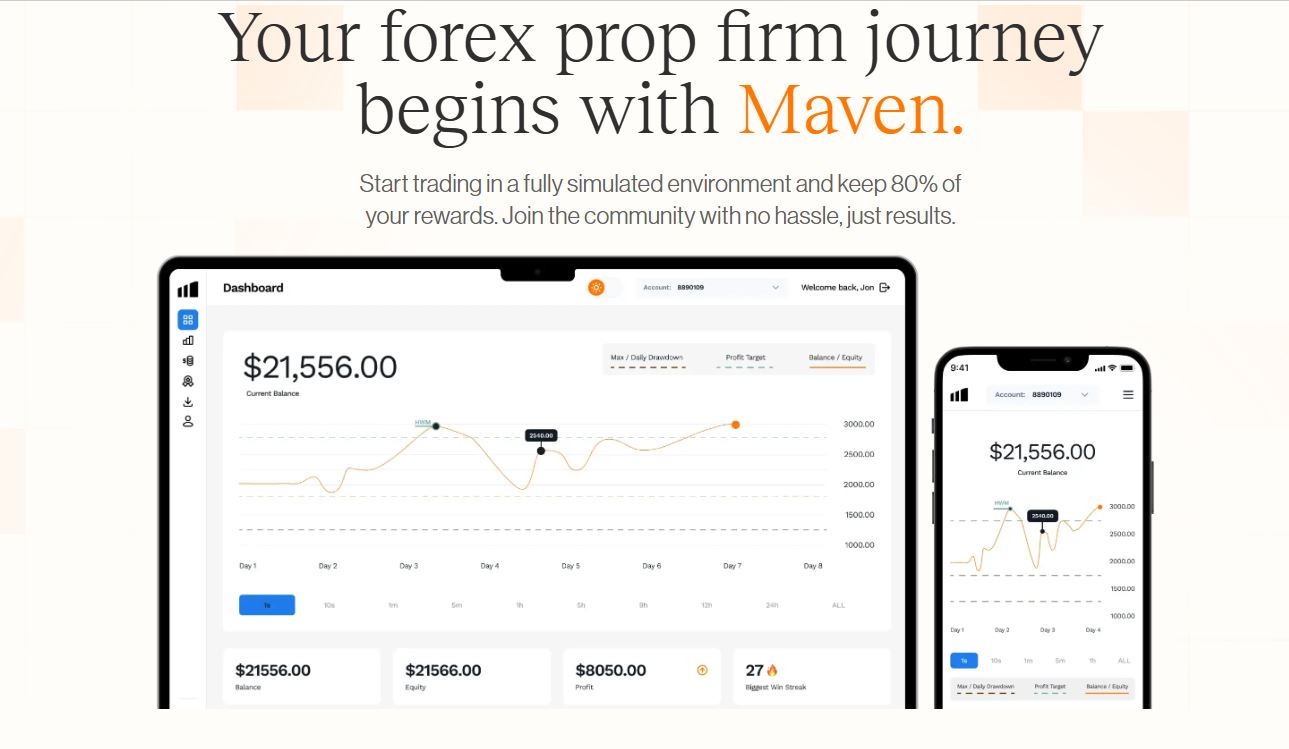
Maven Trading is a proprietary trading firm that provides traders with access to simulated funded accounts. Instead of depositing large sums of personal capital into live markets, traders pay a one-time evaluation fee to participate in a challenge. If they meet specific performance targets while respecting risk management rules, they receive a funded account and can earn a share of the profits generated.
It is important to clarify that Maven Trading does not function as a traditional broker. Traders do not directly deposit trading capital into live financial markets through the firm. Instead, the model typically operates through simulated trading environments where performance is tracked according to predefined conditions.
The company markets itself as accessible, flexible, and supportive of traders worldwide. Its website highlights competitive profit splits, fast payouts, and simplified evaluation processes.
2. How the Business Model Works
Like most prop firms, Maven Trading operates on a challenge-based evaluation system. Here is how the model generally works:
-
Purchase a Challenge
Traders select an account size (for example, $10,000, $50,000, or $100,000) and pay a fee to enter the evaluation phase. -
Meet Performance Targets
The trader must reach a predefined profit target within specific risk parameters, such as:-
Maximum daily drawdown
-
Maximum overall drawdown
-
Minimum trading days
-
Consistency rules (in some cases)
-
-
Pass the Evaluation Phase
Some accounts may require a one-step evaluation, while others may require two phases before qualification. -
Receive a Funded Account
After successful completion, the trader receives a funded (simulated) account and can begin earning profit splits. -
Profit Sharing
Traders keep a percentage of profits, often advertised as up to 80% or more depending on account type and promotions.
The firm generates revenue primarily from challenge fees and, potentially, from risk management arrangements tied to simulated trading.

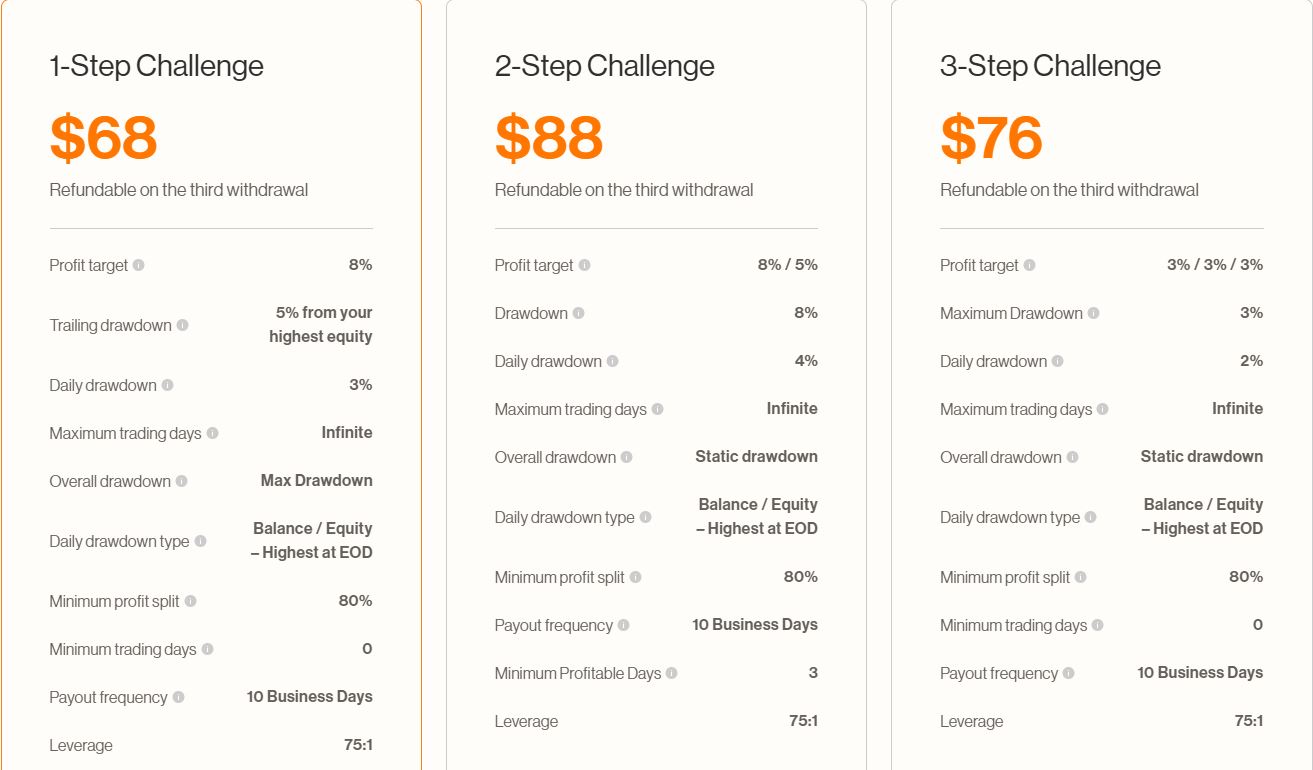
3. Account Types and Challenge Structure
Maven Trading typically offers multiple account sizes to accommodate traders with different risk profiles and financial capacities. Common features include:
-
Account sizes ranging from small ($5K–$10K) to larger capital allocations ($100K+).
-
One-step and two-step evaluation options.
-
Fixed maximum drawdown limits.
-
Daily loss limits.
One-Step vs. Two-Step Challenges
One-Step Challenge
This model requires the trader to hit a profit target in a single phase while respecting the drawdown rules. It is simpler and faster but may come with a higher entry fee or stricter conditions.
Two-Step Challenge
The trader must pass Phase 1 (often with a higher profit target), then Phase 2 (usually a smaller profit target) before qualifying for funding. This approach spreads risk and may reduce pressure.
The availability of both options provides flexibility, which is one of Maven Trading’s strengths.
4. Trading Conditions
While specific details may vary, the key trading conditions usually include:
-
Access to major forex pairs
-
Indices
-
Commodities
-
Possibly cryptocurrencies
The spreads, commissions, and execution quality are important factors. Some users in the prop trading community emphasize that execution quality can vary between firms. Slippage, spread widening, and order execution delays can impact performance significantly, particularly for scalpers and news traders.
Before committing to a challenge, traders should carefully review:
-
Allowed trading strategies (scalping, swing trading, EAs)
-
News trading rules
-
Weekend holding permissions
-
Consistency rules
Transparent rule documentation is essential for trust.
5. Profit Split and Scaling
One of the biggest attractions of any prop firm is the profit split percentage.
Maven Trading advertises competitive splits, often around:
-
80% to the trader
-
20% retained by the firm
Some firms increase the split over time as traders demonstrate consistency. Scaling plans may allow traders to increase their account size after achieving certain profit milestones.
A scaling model typically works like this:
-
Achieve X% profit over a defined period.
-
Maintain risk compliance.
-
Receive an account size increase (e.g., from $50K to $75K or $100K).
Scaling can be attractive because it allows consistent traders to grow their capital allocation without increasing personal financial risk.
6. Payout System
Another critical element is the payout process.
Maven Trading promotes relatively frequent payouts (for example, every 10 trading days or monthly). Key considerations include:
-
Minimum withdrawal threshold
-
Processing time
-
Available payment methods (crypto, bank transfer, etc.)
-
Verification requirements
Community feedback about payout reliability is one of the strongest indicators of legitimacy. While marketing materials often promise fast payouts, real user experiences are crucial.
7. Reputation and Community Feedback
As with most prop firms, public opinion is mixed.
Positive Feedback
-
Clean website interface.
-
Straightforward evaluation structure.
-
Competitive pricing relative to account size.
-
Fast onboarding process.
Negative Feedback
-
Some traders mention spread issues.
-
Complaints about slippage during volatile periods.
-
Confusion around certain rules or technicalities.
It is worth noting that the prop trading space overall is controversial. Many traders fail challenges due to strict drawdown rules rather than lack of trading skill.
When researching, it is helpful to compare Maven Trading with established competitors such as FTMO, which has built a strong reputation over several years.
8. Strengths of Maven Trading
1. Flexible Challenge Options
Offering both one-step and two-step models appeals to different trader personalities.
2. Competitive Profit Split
An 80% split is aligned with industry standards and attractive for skilled traders.
3. Accessible Entry Costs
Compared to managing real capital, challenge fees are significantly lower.
4. Scaling Potential
The ability to grow account size is motivating for consistent performers.
5. Global Accessibility
The firm appears open to traders worldwide, increasing inclusivity.
9. Weaknesses and Risks
1. Evaluation Pressure
Profit targets combined with strict drawdown limits create psychological pressure.
2. Industry Risk
The prop firm industry is relatively new and evolving. Regulatory clarity varies by jurisdiction.
3. Rule Complexity
Even small rule violations (e.g., daily drawdown breach) can disqualify traders instantly.
4. Execution Concerns
Some traders report unfavorable trading conditions during high volatility.
5. No Guaranteed Success
Statistically, many traders fail evaluation challenges multiple times.
10. Who Is Maven Trading Suitable For?
Maven Trading may be suitable for:
-
Traders who already have a proven strategy.
-
Individuals with strong risk management discipline.
-
Traders who can handle psychological pressure.
-
Those seeking exposure to larger capital without risking personal savings.
It may not be suitable for:
-
Complete beginners.
-
Individuals relying on trading as their only income.
-
Traders who struggle with strict risk limits.
11. Psychological Considerations
Prop firm challenges are not only technical but psychological tests.
Common difficulties include:
-
Overtrading to hit profit targets quickly.
-
Revenge trading after losses.
-
Fear of violating drawdown rules.
-
Stress from daily loss caps.
Success often depends more on discipline than on strategy alone.
12. Comparison with Other Prop Firms
Compared to major competitors:
| Feature | Maven Trading | Larger Established Firms |
|---|---|---|
| Industry Experience | Relatively newer | Longer track record |
| Profit Split | Competitive | Competitive |
| Brand Recognition | Growing | Strong |
| Trust Level | Developing | Established |
Established firms may offer more stability, while newer firms sometimes offer more aggressive promotions and flexible rules.

13. Transparency and Legitimacy Considerations
Key questions to evaluate:
-
Is company information clearly stated?
-
Are rules explained in detail?
-
Are payout proofs verifiable?
-
Is customer support responsive?
Traders should always perform independent research and avoid relying solely on promotional materials.
14. Cost vs. Reward Analysis
A typical scenario:
-
Pay $300–$600 for a mid-sized challenge.
-
Pass evaluation.
-
Earn 80% of profits on a $50,000 account.
-
Generate 5% monthly = $2,500.
-
Keep $2,000 after split.
However, this assumes consistent profitability and rule compliance. Many traders fail before reaching the funded stage.
15. Long-Term Sustainability
A major question in the prop firm industry is sustainability.
Prop firms rely heavily on challenge fees. If too many traders pass and withdraw large profits, business models can be pressured. Therefore, risk management systems and simulated environments are critical.
Sustainability depends on:
-
Balanced pass rates.
-
Transparent policies.
-
Strong financial management.
-
Positive reputation growth.
16. Final Verdict
Maven Trading represents a modern prop trading firm offering competitive profit splits, flexible evaluation models, and scaling potential. For disciplined and experienced traders, it can provide an opportunity to access larger simulated capital without risking significant personal funds.
However, participation carries financial risk through challenge fees, strict rules, and the high probability of failure common in the industry. Execution conditions and rule clarity should be carefully reviewed before purchasing any evaluation.
As with all financial decisions, careful research, realistic expectations, and disciplined risk management are essential.
Conclusion
Maven Trading is neither a guaranteed shortcut to wealth nor inherently problematic. It is a structured trading evaluation platform operating within a fast-growing but competitive and sometimes controversial industry.
For traders who already demonstrate consistency and emotional control, Maven Trading may serve as a stepping stone toward managing larger capital allocations. For beginners, it may function better as a learning experience rather than an income solution.
Ultimately, success depends not on the firm alone, but on the trader’s skill, discipline, and understanding of risk.
If approached carefully and realistically, Maven Trading can be a viable opportunity — but never a guarantee.