
Contents
- 1. Introduction
- 2. What Is MegaTrader?
- 3. Business Model and How MegaTrader Works
- 4. Account Types and Pricing Structure
- 5. Trading Platform: MegaTraderX
- 6. Tradable Instruments
- 7. Rules and Risk Management
- 8. Payouts and Withdrawals
- 9. Reputation and User Feedback
- 10. Advantages of MegaTrader
- 11. Potential Risks and Disadvantages
- 12. Who Is MegaTrader Best Suited For?
- 13. Comparison With Other Prop Firms
- 14. Final Verdict
1. Introduction
In recent years, proprietary trading firms (commonly known as prop firms) have become increasingly popular among retail traders worldwide. These firms offer an alternative path for traders who possess skill and discipline but lack sufficient capital to trade at scale. Instead of risking large amounts of personal funds, traders can participate in evaluation challenges, demonstrate consistent performance, and gain access to funded trading accounts.
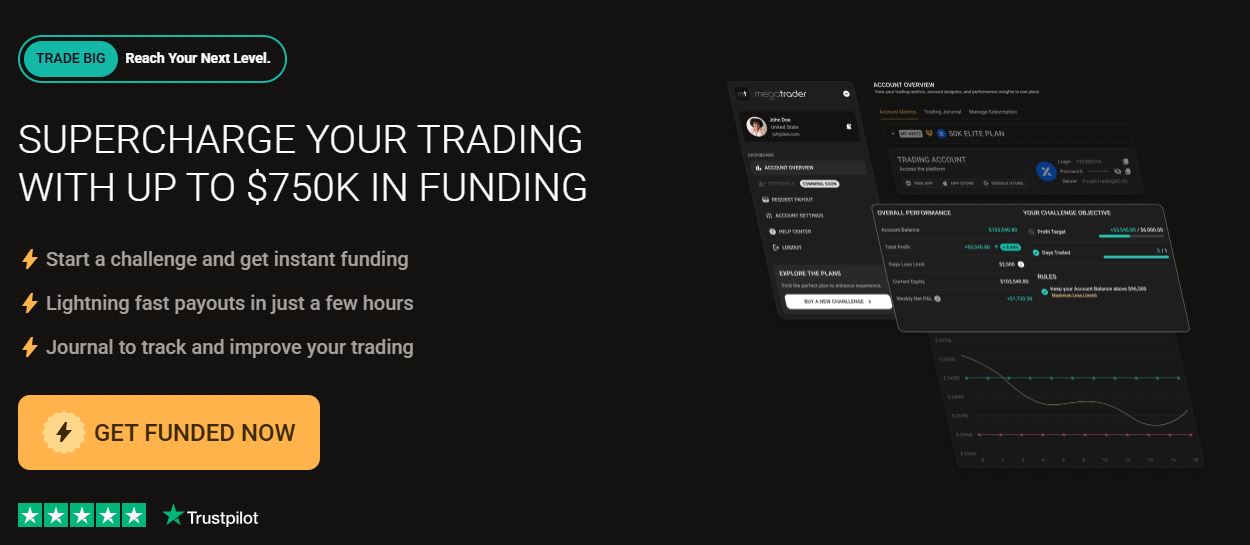
MegaTrader (megatrader.io) positions itself as one of these modern prop trading platforms. It promises low entry costs, fast payouts, a proprietary trading platform, and high profit-sharing ratios. On the surface, MegaTrader appears attractive to aspiring traders looking for capital and professional trading conditions. However, as with any financial service—especially in the trading and prop firm space—it is essential to analyze the platform carefully, understand how it works, and evaluate both its strengths and potential risks.
This review provides a comprehensive and unbiased analysis of MegaTrader. It explores the company’s business model, trading rules, platform features, funding process, pricing structure, advantages, drawbacks, and overall credibility. The goal is not to promote or discourage participation, but rather to equip readers with enough information to make informed decisions.
2. What Is MegaTrader?
MegaTrader is an online proprietary trading firm that allows traders to participate in evaluation challenges and potentially receive funded trading accounts. Unlike traditional brokerage accounts, where traders deposit and trade their own capital, MegaTrader operates on a performance-based model.
The general process is straightforward:
-
Traders purchase a trading challenge.
-
They trade on a simulated (demo) account using real market data.
-
If they meet predefined profit targets while respecting risk rules, they pass the challenge.
-
Successful traders are offered a funded account and can earn a percentage of the profits they generate.
MegaTrader claims to support traders with various account sizes, flexible trading conditions, and fast withdrawals. The platform markets itself as accessible to both beginner and experienced traders, with entry prices that are relatively low compared to some competitors in the prop trading industry.
3. Business Model and How MegaTrader Works
3.1 Evaluation-Based Prop Trading
MegaTrader follows the standard prop firm evaluation model. Traders must first prove their consistency and risk management skills before being entrusted with larger capital. The evaluation phase typically includes:
-
A profit target that must be achieved.
-
A maximum drawdown limit, which restricts how much capital can be lost.
-
Daily loss limits to prevent excessive risk-taking.
-
A minimum number of trading days to discourage gambling-style trading.
Only traders who meet all conditions without violating the rules are eligible for a funded account.
3.2 Simulated Trading Environment
During the challenge phase, traders operate in a simulated environment. While trades use real-time market data, no real capital is at risk. This allows MegaTrader to evaluate performance without exposing the firm to immediate losses.
Funded accounts may still operate in a simulated environment, depending on the firm’s internal risk model. In many modern prop firms, payouts are based on performance rather than direct market exposure.
3.3 Revenue Generation
MegaTrader primarily earns revenue from:
-
Challenge fees paid by traders.
-
Profit splits, where the firm keeps a portion of traders’ profits.
-
Potential ancillary services, such as account upgrades or reset fees.
This model incentivizes the firm to attract a large number of participants, knowing that only a small percentage will successfully pass the challenges.
4. Account Types and Pricing Structure
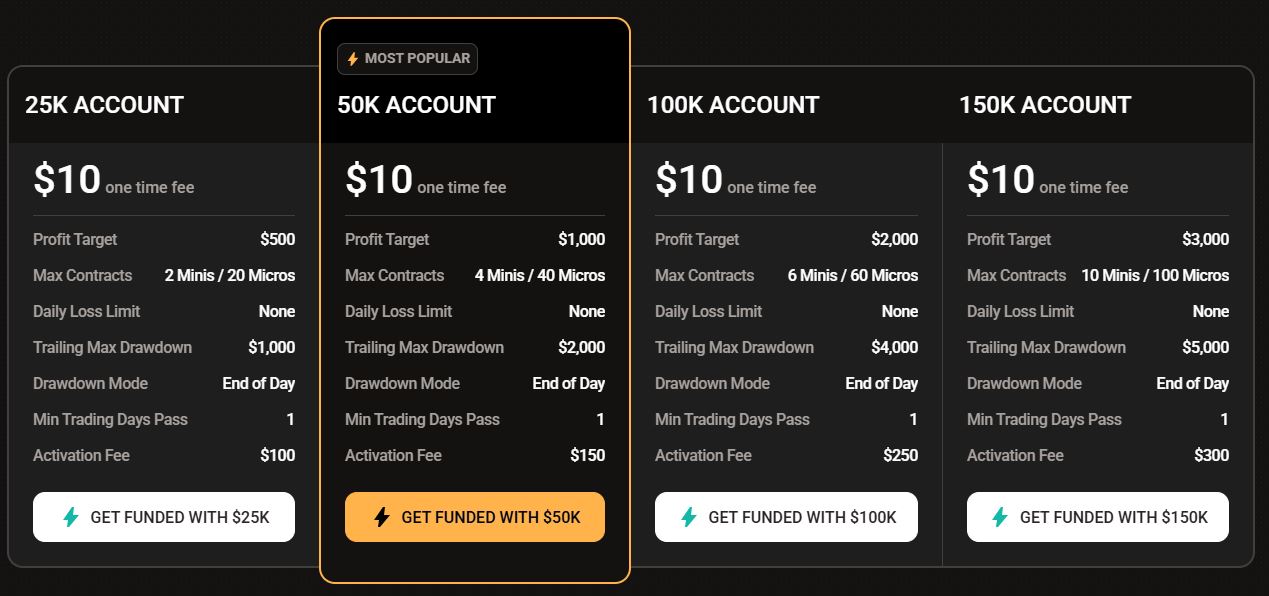
MegaTrader offers multiple account sizes, typically ranging from smaller capital allocations (e.g., $25,000) to larger ones (e.g., $100,000 or more). Each account comes with its own rules and pricing.
4.1 Entry Fees
One of MegaTrader’s marketing highlights is its relatively low entry cost. Some challenges are advertised with fees starting as low as around $10, depending on promotions or account types. This lowers the barrier to entry and makes the platform appealing to beginners.
4.2 Profit Targets and Drawdowns
Each account size has predefined parameters, including:
-
Profit targets (usually a percentage of account balance).
-
Maximum overall drawdown.
-
Daily loss limits.
While these rules are standard in the industry, traders must read them carefully, as even small violations can result in challenge failure.
4.3 Profit Split
MegaTrader advertises a high profit split, often around 90% in favor of the trader. This is competitive within the prop firm industry and aligns with market expectations.
5. Trading Platform: MegaTraderX
5.1 Platform Overview
MegaTrader uses its proprietary platform, MegaTraderX, which is built on DXtrade XT technology. The platform is accessible via:
-
Web browser
-
Mobile applications (iOS and Android)
This eliminates the need for third-party platforms like MetaTrader 4 or MetaTrader 5, which some traders may find either refreshing or limiting.
5.2 Features and Tools
MegaTraderX includes:
-
Advanced charting tools
-
Multiple technical indicators
-
Order types such as market, limit, and stop orders
-
Depth of Market (DOM)
-
Risk management and performance tracking tools
The interface is designed to be modern and user-friendly, appealing to traders who prefer clean dashboards and integrated analytics.
5.3 Limitations
While proprietary platforms can be optimized for specific use cases, they may also lack the flexibility, automation, and community support found in widely used platforms. Traders who rely on custom indicators, expert advisors, or algorithmic strategies may find MegaTraderX restrictive.
6. Tradable Instruments
MegaTrader typically offers access to major financial markets, which may include:
-
Forex currency pairs
-
Indices
-
Commodities
-
Possibly cryptocurrencies (depending on account type and region)
The exact list of instruments can vary, and traders should confirm asset availability before purchasing a challenge.
7. Rules and Risk Management
7.1 Importance of Rules
Rules are central to MegaTrader’s evaluation process. Many traders fail not because they are unprofitable, but because they violate technical rules.
7.2 Common Rules
Typical rules include:
-
Maximum daily loss
-
Maximum overall drawdown
-
No trading during restricted times (if applicable)
-
Minimum number of trading days
These rules encourage disciplined trading but can also feel restrictive, especially for short-term or high-frequency traders.
7.3 Psychological Impact
The presence of strict rules can influence trader psychology. Some traders perform worse under pressure, while others benefit from the enforced discipline. Understanding one’s trading style is critical before joining a prop firm like MegaTrader.

8. Payouts and Withdrawals
8.1 Withdrawal Process
MegaTrader claims to offer fast withdrawals, sometimes within one hour of request. This is a strong selling point, as delayed payouts are a common complaint in the prop firm industry.
8.2 Payment Methods
The platform supports various payout methods, which may include:
-
Cryptocurrencies
-
Online payment processors
-
Bank transfers (depending on region)
Availability can vary based on location and regulatory considerations.
8.3 Transparency Concerns
While fast payouts are attractive, traders should carefully review payout conditions, minimum withdrawal amounts, and profit split rules. Transparency in these areas is essential for long-term trust.

9. Reputation and User Feedback
9.1 Mixed Reviews
Online feedback about MegaTrader is mixed. Some users report positive experiences, including smooth platform performance and quick payouts. Others raise concerns about rule enforcement, account closures, or customer support responsiveness.
9.2 Trust Indicators
Factors that may raise caution include:
-
Limited public information about company ownership
-
Relatively young domain age compared to established prop firms
-
Aggressive marketing language
These factors do not automatically indicate wrongdoing, but they do warrant careful consideration.
10. Advantages of MegaTrader
MegaTrader offers several notable advantages:
-
Low barrier to entry with affordable challenge fees.
-
High profit split, attractive to skilled traders.
-
Modern proprietary platform accessible across devices.
-
Fast withdrawal claims, which appeal to active traders.
-
Structured trading rules that promote risk management.
11. Potential Risks and Disadvantages
Despite its strengths, MegaTrader also has potential drawbacks:
-
Strict rules, which can be difficult for some trading styles.
-
Limited transparency regarding company structure.
-
Proprietary platform limitations for advanced or automated traders.
-
Mixed user reviews, indicating inconsistent experiences.
-
Inherent prop firm risk, where challenge fees may be lost.
12. Who Is MegaTrader Best Suited For?
MegaTrader may be suitable for:
-
Traders with proven strategies and strong discipline.
-
Beginners who want low-cost exposure to prop trading.
-
Traders comfortable with discretionary trading.
-
Individuals seeking experience before trading personal capital.
It may be less suitable for:
-
Algorithmic traders.
-
Traders who dislike strict rule enforcement.
-
Individuals expecting guaranteed income.
13. Comparison With Other Prop Firms
Compared to larger, more established prop firms, MegaTrader emphasizes affordability and speed. However, established firms may offer:
-
Greater transparency
-
Longer track records
-
Broader platform support
Choosing between MegaTrader and competitors ultimately depends on individual priorities.
14. Final Verdict
MegaTrader represents a modern, accessible entry into the world of proprietary trading. Its low-cost challenges, high profit split, and sleek trading platform make it appealing, especially to new traders. However, like all prop firms, it carries inherent risks, and its mixed reputation suggests that traders should proceed with caution.
MegaTrader is neither a guaranteed opportunity nor an outright scam based solely on available information. It is a business operating within a competitive and often controversial industry. Traders who approach it with realistic expectations, strong risk management, and thorough rule comprehension may find value in the platform.
As always, traders should never risk money they cannot afford to lose and should view prop trading as a skill-based opportunity rather than a shortcut to financial success.