
Contents
Introduction
Over the last few years, the online trading industry has expanded far beyond traditional brokers and exchanges. A new business model known as “prop trading challenges” or “funded account programs” has emerged, offering traders the chance to prove their skills in simulated environments and potentially earn payouts without risking their own large capital. This model has grown rapidly because it lowers entry barriers and appeals to aspiring retail traders who lack significant starting funds.
Among the many platforms adopting this structure is NEOMAAA Funded, a project that presents itself as a funded trading challenge provider. The platform advertises large “funded accounts,” attractive profit splits, and a straightforward evaluation process designed to test a trader’s consistency and risk management.
However, like many services in this niche, it is important to clearly understand what the platform truly offers, what it does not offer, and what risks or limitations may exist before participating. This review provides a comprehensive, balanced, and critical look at the project, covering its business model, features, strengths, weaknesses, transparency, user experience, and suitability for different types of traders.
This article is informational only and should not be interpreted as financial advice.

What Is NEOMAAA Funded?
NEOMAAA Funded operates as a simulated proprietary trading evaluation platform, not as a regulated broker or investment fund.
Instead of depositing money and trading live markets directly, users:
-
Purchase a challenge or evaluation plan
-
Receive a demo/simulated trading account
-
Trade under specific rules (profit targets, drawdown limits, timeframes)
-
If they pass, they receive access to a “funded” account
-
Earn a share of simulated profits as payouts
This structure resembles many modern prop-style trading programs.
It’s crucial to understand:
-
You are not investing money into markets
-
You are not receiving capital ownership
-
You are not trading real funds on your behalf
Rather, you are participating in a skills assessment environment that rewards performance under predefined rules.
This distinction matters because expectations around risk, regulation, and returns must be very different from traditional investing or brokerage services.
Core Concept and Business Model
The platform’s business model is relatively straightforward:
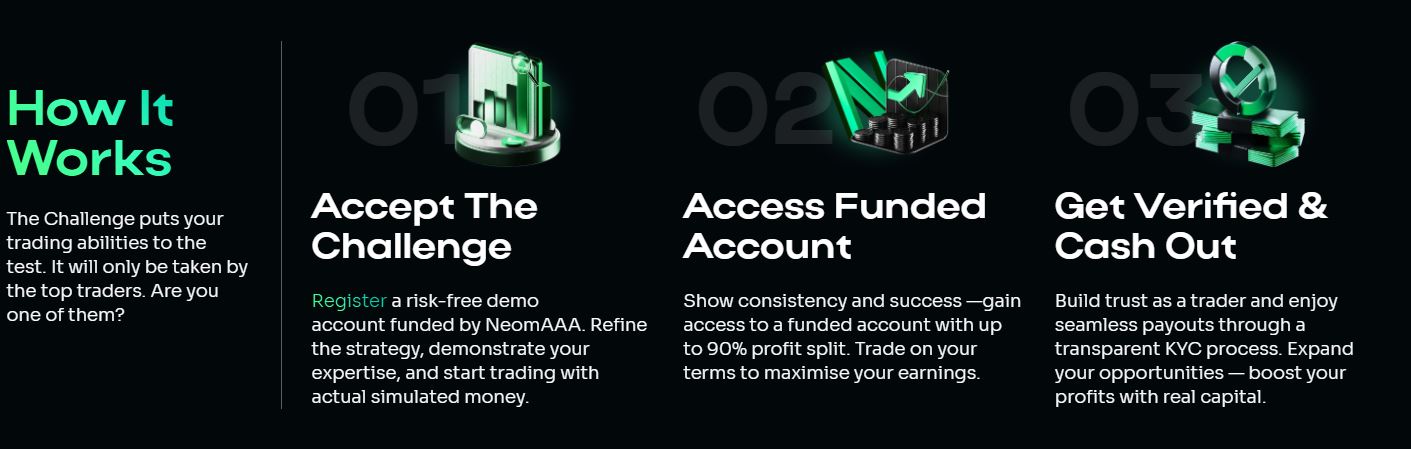
Step 1 – Buy a Challenge
Users pay an upfront fee to access a trading challenge. Different tiers typically offer different virtual account sizes (for example: $25K, $50K, $100K, or larger).
Step 2 – Trade Under Rules
Traders must meet specific requirements such as:
-
Profit target
-
Maximum daily drawdown
-
Maximum overall drawdown
-
Risk management compliance
-
Time or consistency requirements
Step 3 – Get Funded Status
If successful, traders move to a funded or “verified” account stage.
Step 4 – Receive Profit Share
Profits generated inside the simulated system may be shared with the trader, often advertised as high percentages (sometimes up to 80–90%).
How the Company Makes Money
Revenue generally comes from:
-
Challenge fees
-
Failed attempts
-
Reset fees
-
Upgrades
-
Subscription-style renewals
This means the company’s profitability depends more on participation volume than on traders’ success.
That’s not inherently bad, but it explains the incentives behind the business.
Platform Features
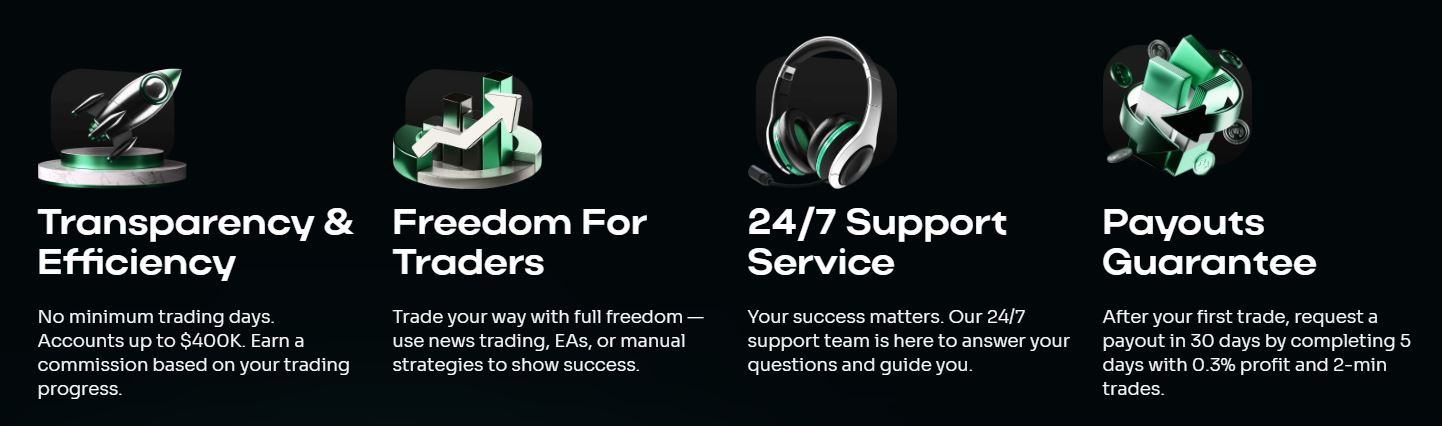
While specifics can change over time, the platform typically promotes features such as:
1. Large Virtual Account Sizes
Traders can operate accounts much larger than they could personally fund.
This is appealing psychologically and practically because it:
-
Reduces personal capital risk
-
Allows larger position sizes
-
Mimics professional trading environments
2. High Profit Splits
The marketing emphasizes generous profit-sharing percentages.
These splits are designed to attract experienced traders looking for scalable income opportunities.
3. Risk-Control Framework
Rules like drawdown limits encourage disciplined trading habits. This can be beneficial for developing consistency and professional risk management skills.
4. Structured Evaluation
The challenge format introduces measurable goals and performance tracking, which some traders find motivating.
5. Remote Access
Everything operates online, allowing global participation without geographic restrictions (except where legally limited).
Strengths of NEOMAAA Funded
Clear Simulation Model
The platform openly states that trading is simulated. This level of clarity is important and helps prevent misunderstandings about real capital involvement.
Low Barrier to Entry
Instead of needing thousands of dollars to trade live, users can start with a relatively small fee.
For beginners or undercapitalized traders, this is attractive.
Skill-Focused Approach
Because profits depend on meeting strict rules, traders must:
-
Manage risk carefully
-
Avoid overleveraging
-
Follow disciplined strategies
These are habits that benefit long-term traders.
Structured Progression
The step-by-step evaluation process provides clear milestones and measurable goals, which can help traders assess their own performance objectively.
No Real Capital Risk
Since everything is simulated, traders avoid catastrophic financial losses that often occur with live accounts.

Weaknesses and Limitations
Despite the positives, there are important downsides.
Not a Broker or Investment Platform
Users expecting real market participation may be disappointed.
This is not:
-
A brokerage account
-
An exchange
-
A managed fund
-
An investment service
It is essentially a performance-testing system.
Upfront Costs Add Up
Repeated attempts or resets can become expensive. Many traders fail multiple times before passing.
Fees can accumulate quickly, sometimes exceeding what a trader would risk in a small live account.
Rule Complexity
Strict rules may feel artificial:
-
Daily drawdowns
-
Consistency limits
-
Trade restrictions
These do not always reflect real market conditions.
Some traders feel the rules are designed more to filter out participants than to simulate authentic trading.
Psychological Pressure
The evaluation format can encourage:
-
Overtrading
-
Rushed decisions
-
Risky behavior to hit targets fast
Ironically, this can hurt performance.
Regulatory Ambiguity
Because it’s not a regulated broker, protections common in financial markets (segregated funds, licensing oversight, compensation schemes) usually do not apply.
Participants rely heavily on the company’s internal policies.
Transparency and Trust Considerations
When evaluating any prop trading platform, several questions matter:
-
Is the company registered?
-
Are rules clearly stated?
-
Are payouts verifiable?
-
Is customer support responsive?
-
Are terms fair and consistent?
From a general standpoint, traders should always read:
-
Terms of service
-
Refund policies
-
Payment conditions
-
Payout rules
-
Disqualification triggers
Even small clauses can significantly impact eligibility for payouts.
Due diligence is critical.
Who Is It Suitable For?
Good Fit For:
-
Traders wanting practice without real capital risk
-
People testing strategies
-
Traders seeking structured discipline
-
Those comfortable with simulated environments
-
Individuals who treat fees as “education costs”
Probably Not Ideal For:
-
Investors expecting real asset growth
-
People seeking regulated financial services
-
Those with tight budgets who can’t afford repeated challenge fees
-
Traders who dislike strict rule systems
Comparison With Traditional Trading
| Aspect | NEOMAAA Model | Traditional Broker |
|---|---|---|
| Real capital | No | Yes |
| Regulation | Limited | Usually regulated |
| Risk to personal funds | Low | High |
| Profit realism | Simulated | Real market |
| Ownership of funds | No | Yes |
| Fees | Challenge-based | Spread/commission |
This comparison shows the fundamental difference: one is an evaluation service, the other is genuine market participation.
Risk Assessment
Key risks include:
-
Paying fees without ever passing
-
Misunderstanding the simulated nature
-
Overestimating income potential
-
Relying on marketing promises
-
Lack of regulatory protection
Traders should treat participation as a training or gamified skill challenge, not an investment strategy.
Overall Impression
NEOMAAA Funded sits squarely within the growing “prop challenge” category. It is neither revolutionary nor suspicious by default — simply another platform applying a well-known model.
Its value depends heavily on user expectations.
If someone expects:
“Free capital and easy money” → disappointment likely.
If someone expects:
“A structured trading simulation to test my skills” → it may be useful.
The difference lies entirely in mindset.
Final Verdict
NEOMAAA Funded can be seen as:
-
A trading simulator with incentives
-
A paid evaluation platform
-
A skill-testing environment
It is not a broker, fund, or investment opportunity.
Used responsibly, it can help traders practice discipline and risk management. Used with unrealistic expectations, it can lead to wasted money and frustration.
Recommendation
Participate only if:
-
You understand it’s simulated
-
You can afford the fees
-
You want structured practice
-
You don’t rely on it for guaranteed income
Never treat it as a replacement for regulated trading or real investing.