The Platform That Ate the Market in Weeks
Every crypto cycle produces a handful of tools that traders swear by and a graveyard of ones nobody remembers. In the Solana memecoin world — a corner of crypto that moves faster and burns hotter than almost anything else in finance — a small number of “trading terminals” have become the default cockpit for anyone trying to catch the next 100x before it’s gone. Axiom Trade is, right now, the one everyone is talking about.
It wasn’t first. Photon, BullX, and GMGN were already fighting for the same audience of Solana degens when Axiom showed up. And yet, in a matter of months, Axiom didn’t just carve out a niche — it reportedly climbed to a dominant share of the Solana terminal market, with some trackers putting its peak share above 70%. That is not a small feat in a category defined by copycats, forks, and traders who will abandon a tool the moment a millisecond of latency costs them money.
So what actually is Axiom Trade, why did it blow up so fast, and is it worth your time (and your SOL)? Let’s break it down properly.
Try Axiom Trade Now →
What Exactly Is Axiom Trade?
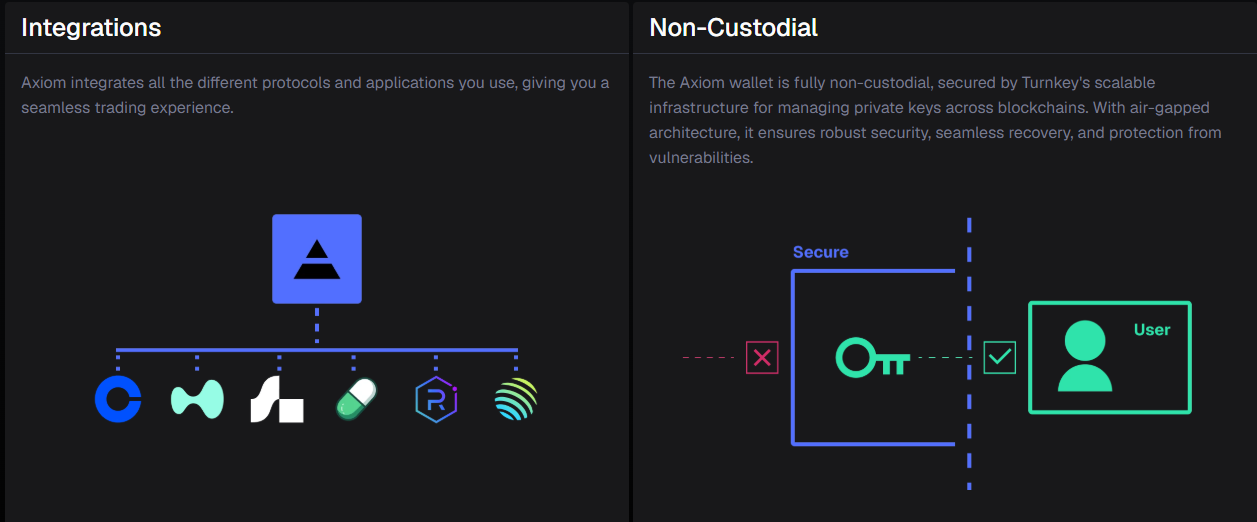
At its core, Axiom is a web-based, non-custodial trading terminal built on top of Solana. “Non-custodial” is the key word here — you are never handing your coins or your private keys over to Axiom’s servers the way you would with a centralized exchange. Instead, Axiom acts as a slick front-end that routes your trades through the decentralized exchanges that actually hold the liquidity: Raydium, Orca, Meteora, and the various bonding-curve launchpads where memecoins are born, most notably pump.fun-style token launches.
Think of Axiom less like “an exchange” and more like a cockpit — a single dashboard where you can discover new tokens the moment they launch, analyze them, watch what smart money is doing with them, and execute a trade in one click, all without leaving the tab or juggling a Telegram bot, a block explorer, and three browser extensions at once.
The company behind it went through Y Combinator’s S23 batch, which gave it a credibility bump that most anonymous Telegram trading bots simply don’t have. According to figures shared publicly by the team, Axiom has scaled to eight figures in monthly recurring revenue with several million dollars in monthly net profit — numbers that, whatever you think of memecoin trading as an activity, confirm that an enormous amount of real capital is flowing through this platform every single day.
Why Speed Is the Entire Game
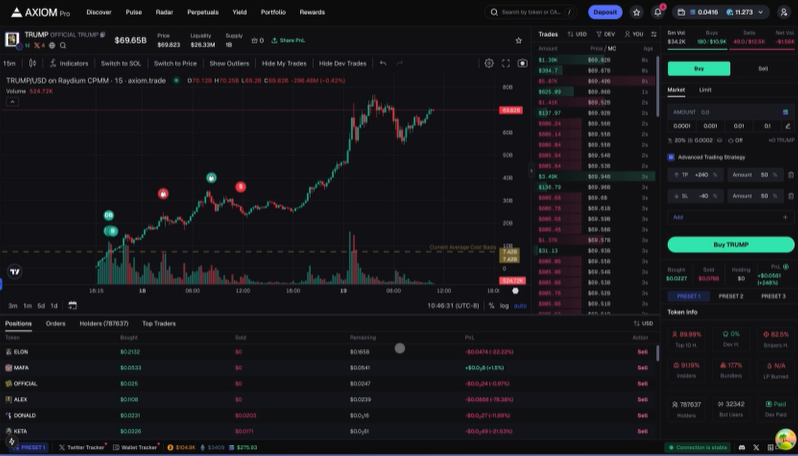
To understand why a tool like Axiom exists at all, you need to understand the environment it was built for. Memecoin trading on Solana isn’t investing in the traditional sense — it’s closer to high-frequency trading crossed with a casino floor. Tokens can launch, pump 50x, and rug within minutes. The difference between a profitable trade and a total loss frequently comes down to a few hundred milliseconds of execution speed and whether your transaction lands in the right block.
That’s the exact pain point Axiom was built to solve. Instead of switching between a charting site, a separate DEX aggregator, a Telegram sniper bot, and a spreadsheet to track your positions, Axiom compresses the entire workflow into one interface with a proprietary execution engine designed to minimize the friction between “I see an opportunity” and “I’m in the trade.” One-click buys, pre-set slippage and priority-fee configurations, and Quick Buy presets mean a trader can react to a launch in the time it takes to read a chart, not the time it takes to open four different apps.
Independent testing from trading-focused review sites has generally found Axiom’s fill times to be essentially tied with BullX for the fastest in the category, and ahead of GMGN, which trades some execution speed for a deeper analytics layer instead.
The Feature Stack: What You Actually Get
Axiom isn’t just a fast “buy” button. It’s a genuinely feature-dense product, and understanding the full stack is where you start to see why it pulled so much market share so quickly.
Pulse: The Discovery Engine
The centerpiece of the platform is Pulse, Axiom’s live token discovery dashboard. Rather than manually scrolling block explorers hoping to spot a fresh launch before everyone else, Pulse surfaces new and trending tokens in real time and lets you filter by variables that actually matter to a memecoin trader: token age, liquidity depth, sniper percentage, holder concentration, and volume momentum. For a category where thousands of tokens can launch on a single busy day, this filtering layer is arguably as important as the execution speed itself — it’s the difference between finding a genuine opportunity and drowning in noise.
Smart Wallet Tracking and Copy Trading
One of Axiom’s most talked-about features is its built-in wallet tracker. You can follow specific wallets — whether that’s a known “smart money” address, a profitable trader you’ve identified, or an insider wallet you want to keep an eye on — and see their entries, exits, position sizes, and historical performance in real time. Some traders use this purely for research; others lean on it to essentially shadow-copy the moves of wallets with strong track records. Axiom layers filters on top of this too, including win-rate thresholds, PnL minimums, and cooldown periods, so you’re not just blindly following every transaction a wallet makes.
Social Intelligence Straight From X
Instead of tabbing over to X (formerly Twitter) to manually search for a token’s ticker and gauge sentiment, Axiom pipes relevant tweet feeds directly into the dashboard. Curated commentary from trusted crypto accounts, developer updates, and trending narrative signals show up alongside the chart you’re already looking at — which matters enormously in a market where a single influencer post can move a token’s price within seconds.
Execution Controls Built for Volatility
Axiom gives traders granular control over the mechanics that actually determine whether a trade lands or fails during a chaotic launch: slippage tolerance, priority fees, and MEV-protection settings to reduce the odds of getting sandwiched by bots. On top of that sit standard market orders, limit orders, and automated take-profit/stop-loss logic — tools that used to require a separate bot subscription now sitting natively inside the terminal.
Beyond Memecoins: Staking and Perpetuals
Axiom has expanded well past pure memecoin sniping. The platform now offers axiSOL, a staking product that lets users earn yield on idle SOL rather than leaving it sitting dormant between trades. It has also integrated Hyperliquid to give users access to perpetual futures trading with meaningful leverage — reportedly up to 50x — directly from the same account. This turns Axiom from a single-purpose memecoin sniper into something closer to a full trading suite: spot memecoins, yield, and leveraged derivatives, all under one login.
Frictionless Onboarding
Perhaps the most underrated part of the product is how it handles onboarding. Using Web3Auth technology, Axiom lets new users spin up a “smart wallet” using nothing more than an email address — no browser extension, no seed phrase to write down before you can even look around. For crypto-native power users this might feel unnecessary, but for the wave of newer traders coming in through influencer links and social media, it strips out one of the biggest drop-off points in Web3 onboarding. Experienced users can of course also connect existing wallets like Phantom or MetaMask if they prefer to manage their own keys directly.
Fees: Where Axiom Actually Wins
In a category where every competitor claims to be the cheapest, the numbers are worth laying out plainly.
Axiom uses a tiered fee structure that starts around 0.9%–0.95% per trade at the base tier and can drop as low as 0.7%–0.75% at higher volume tiers, with part of that reduction paid back to active traders as cashback in SOL. For context, on a $1,000 trade, that’s roughly $7–$9 in fees at Axiom versus $10 flat on BullX or Photon, and considerably more on GMGN, which has been reported charging up to 1.5% with no comparable rebate structure.
That gap sounds small on a single trade, but memecoin traders don’t make single trades — they make dozens, sometimes hundreds, in a single session. Multiply a 20–30% fee discount across that kind of volume and it becomes a genuinely material edge over a trading month, separate entirely from whether your actual token picks are any good.
It’s also worth noting that Photon and BullX users frequently report extra “bribe” and “priority tip” costs stacking on top of the headline fee, which can meaningfully raise the real cost of a trade beyond the advertised percentage. Axiom’s all-in fee structure tends to be more predictable by comparison.
Start Trading with Lower Fees →
How Axiom Stacks Up Against the Competition
No review of Axiom is complete without putting it next to the terminals it’s been taking share from. Independent rankings published in 2026 that scored the major Solana terminals across execution speed, fees, security, analytics, and multi-chain coverage consistently put Axiom at or near the top of the category — with one widely cited ranking scoring it 8.1 out of 10 and crediting it with a proprietary execution engine and a peak terminal share above 70% on Solana specifically.
Here’s a rough sketch of how the main players differentiate themselves:
- Axiom — the strongest all-around package on Solana specifically: fastest or tied-fastest execution, the cheapest fee structure at volume, the deepest wallet-tracking and social-intelligence layer, plus staking and perps bolted on. Its weak spot is multi-chain coverage; it’s built primarily for Solana with only limited support elsewhere, and it doesn’t sync with a Telegram bot the way some competitors do.
- Photon — the minimalist’s choice. Lightweight, extremely fast, clean interface, solid Jito MEV protection, but noticeably less feature-dense than Axiom, and it lacks the fee rebate system.
- GMGN — the researcher’s tool. Its AI-driven contract risk scanning and smart-money wallet clustering are arguably the best in the category, and it covers more chains out of the box. But execution speed trails the leaders, and fees run higher. Many traders use GMGN as a research layer feeding into a faster execution tool like Axiom or Photon.
- BullX Neo — the multi-chain generalist. Broadest chain coverage and a Telegram-plus-web setup, but fees run high and users frequently cite extra bribe/tip costs eating into returns.
The honest summary echoed across multiple independent reviews is that these four tools are largely playing the same game with different trade-offs: Axiom wins on cost-at-volume and feature density for Solana-focused traders, BullX wins on chain breadth, GMGN wins on research depth, and Photon wins on sheer simplicity and speed for traders who want the absolute minimum between them and the buy button.
The User Experience: Why It Actually Feels Different
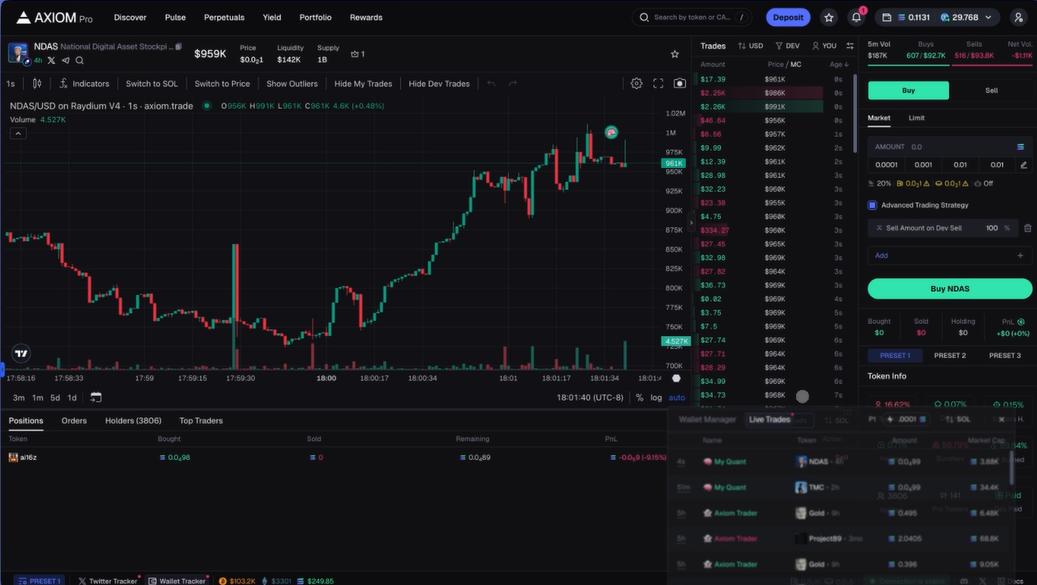
Feature lists only tell half the story — plenty of trading tools have long checklists of capabilities and still feel clunky to actually use under pressure. What seems to have driven Axiom’s rapid adoption isn’t any single feature; it’s that the whole thing is genuinely well-designed. The interface is dense with information without feeling cluttered, the charting is fast, and the workflow from “spot a token on Pulse” to “position is open” is remarkably short. For an audience that lives and dies by reaction time, that polish is not a nice-to-have — it’s the entire value proposition.
Axiom has also leaned heavily into a community-and-rewards layer that has clearly helped fuel its growth: weekly trading competitions with large cash prize pools paid to top-performing traders, referral programs with sticky, multi-tier commission structures, and social features like shared “lobbies” where friends can trade together and compare positions in real time. Combined with visible, vocal support from a wide swath of crypto-Twitter influencers, this social layer turned Axiom from “a tool people use” into something closer to a community people are part of — which is a genuinely powerful growth engine in a space this trend-driven.
The Honest Downsides
No review that only tells you the good parts is worth reading, so let’s be direct about where Axiom falls short and, more importantly, where the risks in this entire category live.
It’s built for one chain. Despite roadmap talk of expanding to Ethereum, Base, and beyond, Axiom’s real strength today is almost entirely Solana-specific. If your trading spans multiple chains, you’ll still need another tool alongside it, or you’ll be leaning on a competitor like BullX or Banana Pro that covers more ground natively.
It doesn’t fix the underlying problem. This is true of every terminal in this category, not just Axiom: none of these tools solve the actual hard part of memecoin trading, which is picking the right token at the right time and exiting before liquidity disappears. Faster execution and better analytics improve your odds at the margins, but they don’t turn a fundamentally high-risk activity into a safe one.
Memecoin trading is genuinely dangerous territory. This can’t be overstated. The assets traded through Axiom are overwhelmingly early-stage, thinly-liquid memecoins with no fundamental value backing them. Rug pulls, where developers drain liquidity and abandon a token, remain common. Even legitimate-looking tokens can lose 90%+ of their value within hours. Reviewers who otherwise rate Axiom highly are consistent on this point: it’s a tool for people who already understand liquidity, slippage, MEV, and rug-pull risk — not a beginner-friendly on-ramp into “safe” crypto investing.
Non-custodial cuts both ways. Not handing your keys to a centralized platform is a real security advantage in principle, but it also means the responsibility for wallet security sits entirely with you. Lose your access, fall for a phishing link, or approve a malicious transaction, and there’s no customer support desk that can reverse it.
So, Who Should Actually Use Axiom?
If you’re an active Solana trader who already understands the mechanics of on-chain trading — slippage, priority fees, liquidity pools, MEV, the works — Axiom is very likely the single best terminal available to you right now. The combination of low fees at volume, fast execution, genuinely useful discovery and wallet-tracking tools, and the added convenience of staking and perps under one login is hard for competitors to match feature-for-feature.
If you’re new to crypto entirely, or you’re looking for a low-risk way to get exposure to the space, this is not that. Memecoin trading terminals — Axiom included — are built for a specific, high-risk, high-attention style of trading. Treat any capital you put into this the way you’d treat money at a casino table: money you can genuinely afford to lose, managed with discipline, not your savings.
The Verdict
Axiom Trade earned its market share the hard way — not through hype alone, but by building a product that’s demonstrably faster, cheaper at volume, and more feature-complete than most of what came before it. It took a category full of tools solving one piece of the puzzle each and stitched them into a single, fast, well-designed cockpit. That’s a rare thing to pull off in crypto, where “all-in-one” platforms usually end up being mediocre at everything instead of great at one thing.
Is it the future of trading, as the platform’s own marketing claims? That’s a big statement for any single product. But within its actual lane — fast, active, on-chain Solana trading — Axiom currently sits at or near the top of a genuinely competitive field, and the data on fees, speed, and market share backs that up rather than just the branding.
The bigger question was never really about the tool. It’s about the game itself. Axiom makes memecoin trading faster, cheaper, and more informed than it used to be — but it’s still memecoin trading. Bring your own risk management, because the terminal, however good it is, won’t bring it for you.
Frequently Asked Questions
Is Axiom Trade safe to use? Axiom is non-custodial, meaning it never takes control of your private keys or funds directly — trades route through your own wallet to established DEXs like Raydium, Orca, and Meteora. That structure removes one major category of risk (a platform freezing or losing your deposits) but does not remove the risks inherent to the assets themselves. The tokens you trade through Axiom are overwhelmingly unaudited, highly speculative memecoins, and rug pulls, honeypots, and sudden liquidity drains remain common across the entire category, regardless of which terminal you use to trade them.
Do I need a crypto wallet to start? Not necessarily. Axiom’s Web3Auth-powered smart wallet lets you create an account and start trading with just an email address, which removes the biggest onboarding hurdle for newcomers. More experienced users can connect an existing wallet like Phantom instead if they prefer to hold their own keys from day one.
What are the real, all-in costs of trading on Axiom? Base trading fees sit around 0.9%–0.95% per transaction, dropping to roughly 0.7%–0.75% at higher-volume tiers, with a portion returned as SOL cashback. On top of that, Solana network fees and any priority-fee or MEV-protection settings you configure will add a small additional cost per trade, though these tend to be lower and more predictable than the “bribe” and “tip” fees frequently reported on some competing terminals.
Is Axiom only for Solana? For all practical purposes, yes, at least for now. Solana is where the execution engine, liquidity routing, and feature set are genuinely mature. The team has talked publicly about expanding to other chains like Ethereum and Base, but as of this review that expansion has not materially changed the day-to-day experience, and traders who need serious multi-chain coverage today are generally better served by a tool like BullX Neo or Banana Pro alongside Axiom.
How does Axiom compare on pure execution speed? In head-to-head testing by independent reviewers, Axiom and BullX have generally come out essentially tied for the fastest fills among the major Solana terminals, with GMGN trailing slightly due to its heavier analytics layer. For traders where speed genuinely decides whether a trade is profitable, that puts Axiom firmly in the top tier rather than simply “competitive.”
Can I actually make money using Axiom? Using a faster, cheaper, better-informed terminal can meaningfully improve your odds at the margins — better fills, lower fees, earlier discovery, and clearer wallet-tracking data all help. But no terminal, Axiom included, changes the underlying math of memecoin trading: most tokens launched on Solana lose the vast majority of their value, and consistent profitability requires real discipline around position sizing, exits, and risk management that no piece of software can substitute for.
Disclaimer: This article is for informational purposes only and does not constitute financial advice. Cryptocurrency trading, and memecoin trading in particular, carries a very high risk of loss. Always do your own research and never trade with money you cannot afford to lose.
👉Create Your Axiom Account in 30 Seconds