
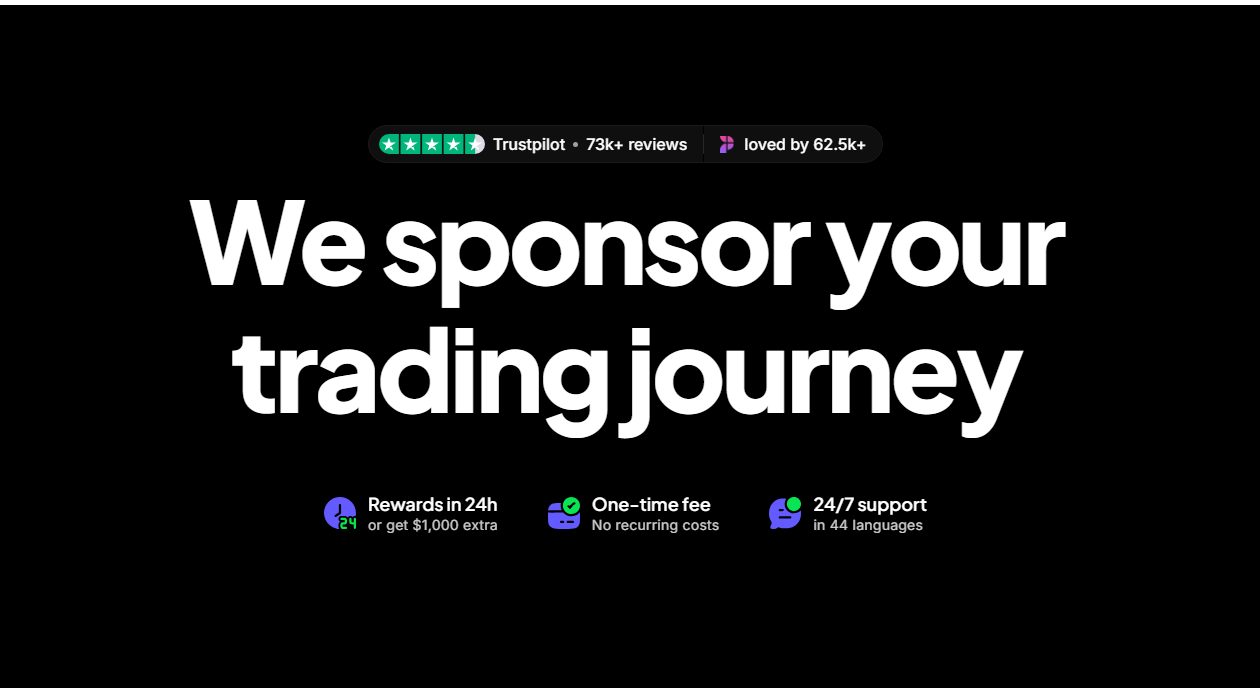
If you’ve spent any time in trading Discord servers, YouTube comment sections, or Reddit threads about proprietary trading firms, you’ve almost certainly run into the name FundedNext. With a Trustpilot score of 4.5 out of 5 from over 73,000 reviews, a claimed community of 62,500+ traders, and a headline figure of more than $300 million paid out to date, FundedNext has positioned itself as one of the most talked-about names in the “funded trader” industry. But headline numbers are cheap in an industry famous for flashy marketing and buried fine print. So let’s actually dig into what FundedNext is, how it works, what it costs, and whether it deserves the hype — or just the traffic.
What Exactly Is FundedNext?
FundedNext is a proprietary trading firm — more precisely, a trading evaluation company. It does not let you trade real money in a live market. Instead, it runs simulated trading environments where you prove you can trade profitably and within a defined set of risk rules. Clear that evaluation, and FundedNext allocates you a “funded” simulated account; from that point on, any profit generated in the simulation is split between you and the firm, typically with the trader keeping the larger share.
This is an important distinction the company itself is careful to spell out in its legal disclosures: FundedNext is not a broker, does not accept client deposits, and does not place you into live markets. Rewards paid to traders are performance-based payouts tied to evaluation results, not withdrawals of your own invested capital. If you’re coming from traditional investing or from a regulated brokerage background, this “pay to play a trading exam, then get paid like a contractor if you pass” model can feel unusual at first — but it’s the standard structure across the entire prop-firm industry, not something unique to FundedNext.
The company operates through a web of corporate entities, which is also fairly typical for this sector: the core operating entity is registered in the Comoros Islands, with a Hong Kong office, and additional entities in the UAE and Cyprus handling payment operations. This offshore, multi-entity structure is common among prop firms — it isn’t necessarily a red flag on its own, but it does mean you’re not dealing with a firm under the kind of direct regulatory oversight you’d expect from an FCA- or SEC-regulated broker. That’s worth internalizing before you commit any money.
Get Started with FundedNextTwo Product Lines: CFDs and Futures
FundedNext has grown beyond a single evaluation product into two distinct trading ecosystems, plus an experimental third:
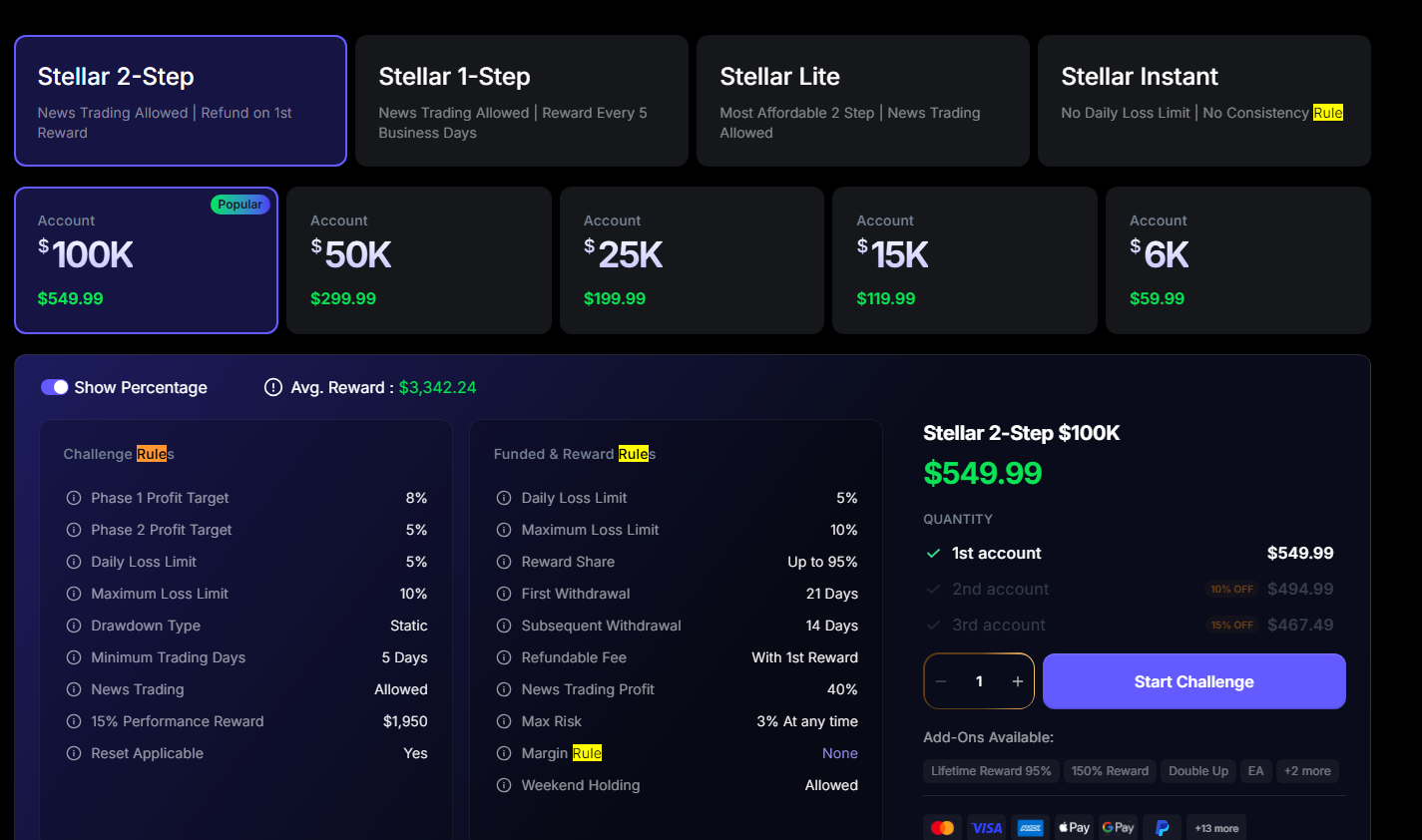
FundedNext CFDs covers forex, indices, commodities, and crypto CFDs, and is built around a family of programs called “Stellar”:
- Stellar 2-Step — the traditional two-phase evaluation model
- Stellar 1-Step — a single-phase evaluation for traders who want to skip the second hurdle
- Stellar Lite — a lower-cost entry point that trims the cash bonus perks found in the other two
- Stellar Instant — a “funded now, evaluate as you go” model with tighter leverage
FundedNext Futures targets futures traders on platforms like Tradovate and NinjaTrader, with its own family of programs:
- Legacy — the long-standing full evaluation model
- Bolt — a more affordable option that drops the consistency rule and benchmark-day requirements
- Flex — a flexible-payout model with an end-of-day trailing drawdown and no artificial buffer rule, plus an optional upgrade to a 90% profit split
- Rapid Pro / Rapid Daily — newer, faster-turnaround programs, with Rapid Daily notably removing the consistency rule entirely and offering daily payouts with a 90/10 split
On top of these sits FundedNext Labs, described on the site as “the launchpad for FundedNext’s boldest trading innovations” — essentially a testing ground for experimental account types (like the CFDs-FNL:002 plan, which offers an 85% reward share and a 12% maximum loss limit) before they potentially graduate into the main lineup.
This breadth is genuinely one of FundedNext’s competitive advantages. A lot of prop firms specialize in either CFDs or futures. FundedNext gives traders a reason to stay inside one ecosystem regardless of which market they prefer, complete with its own economic calendar, symbol lists, and trading-platform comparisons on the website.
Pricing: What You’re Actually Paying For
Across CFDs and futures combined, FundedNext’s challenge fees range roughly from $32 up to $549, depending on account size and program type, with account allocations scaling as high as $200,000 on some plans and up to $300,000 advertised on the marketing pages. As an illustration of futures pricing, the Rapid-style plans list around $79.99 for a 25K account, $149.99 for 50K, and $249.99 for 100K, often discounted 50% or more through promo codes that circulate among affiliate reviewers.
A few pricing details are worth flagging:
- One-time fee, no subscription. FundedNext markets itself heavily on this point — you pay once for your evaluation attempt rather than a recurring monthly charge, which is friendlier than the subscription-style models some competitors use.
- Profit splits range from 80% up to 95%, depending on the plan and whether you purchase an add-on upgrade. The baseline is generally 80%, with paid upgrades (roughly $15–$35 depending on account size) bumping that to 90%.
- An “On-Demand Reward” add-on exists for CFD accounts, priced at an extra 5% of the challenge fee, aimed at traders who want more control over payout timing.
- Discount codes are everywhere. Because FundedNext runs an active affiliate program, you’ll rarely see anyone actually pay full list price — 5–7% off codes (and sometimes bonus cashback on your first payout) are standard practice in this niche, so it pays to shop around before purchasing directly from the homepage.
The Rules: Where Prop Firms Really Live or Die
Marketing pages sell the dream — the drawdown rules are where reality bites. FundedNext, to its credit, publishes a fairly detailed general-rules section, and a few standout mechanics are worth understanding before you fund an account:
The 40% Consistency Rule. This appears across multiple FundedNext programs (though notably not all of them — Rapid Daily and some funded-account phases drop it entirely). In plain terms: your single best trading day cannot account for more than 40% of your total profit. Blow past that ratio, and you’ll need to keep trading to “dilute” that day’s outsized contribution before you can request a payout. This rule exists industry-wide to stop traders from passing an evaluation with one lucky oversized trade, but it does mean your trading has to look consistent, not just profitable.
The News Profit Split Rule. Rather than banning news trading outright (a common and frustrating restriction at other firms), FundedNext takes a more nuanced approach on funded CFD accounts: trades opened or closed within 5 minutes of a high-impact news release only count 40% of their profit toward your balance — but losses in that same window count in full. It’s a smart middle-ground mechanic: it discourages reckless news-spike gambling without stopping you from holding positions through news events, which is a real point in FundedNext’s favor compared to firms that flatly forbid trading around news.
Leverage varies by program, not firm-wide, which catches some traders off guard. Stellar 2-Step and Lite run forex at 1:100 with indices/commodities at 1:25 during evaluation (dropping to 1:15 once funded); Stellar 1-Step is tighter at 1:30 forex; Stellar Instant is the most conservative, at 1:30 forex and single-digit leverage on indices and commodities. Crypto is capped at 1:1 across every model. If you’re a leverage-hungry trader, read the specific plan’s terms — don’t assume the number advertised for one product applies to another.
Weekend and overnight holding is allowed across every CFD model, which is a genuine convenience for swing traders — though swap charges apply over weekends and do eat into your daily loss limit, so it’s not entirely free.
On the futures side, the 2% price limit rule (avoiding trades too close to CME circuit-breaker levels) and the same 40% consistency logic apply to Legacy and Flex challenges, while newer products like Rapid Daily and funded Flex/Legacy accounts drop the consistency requirement altogether — a sign that FundedNext has been iterating its rulebook to compete with rivals who offer looser, trader-friendlier terms.
What’s forbidden reads like a standard industry checklist: high-frequency trading, arbitrage strategies, grid systems that exploit backend latency, account rolling, and unauthorized copy trading between accounts owned by different people. Expert Advisors (EAs) are allowed, but you’re required to use them consistently rather than switching strategies mid-evaluation — a rule that exists to prevent gaming the consistency requirements.
Payouts and Support: The Part That Actually Matters Most
Ultimately, none of the rules or pricing matters if a firm doesn’t pay. This is the single biggest trust issue in the prop-firm industry, and it’s also where FundedNext has invested the most in its marketing: a “$1,000 Brand Promise” guarantees an extra $1,000 payment if your reward isn’t processed within 24 hours, and the firm advertises an average processing time of around 40 hours with a stated 99.99% success rate on payments within that window across 170+ countries.
Support is also a differentiator worth mentioning: FundedNext claims 120+ support agents spread across five global hubs, operating 24/7 in 44 languages, with a first-response time under 25 seconds. Whether or not every number on a marketing page is taken at face value, the sheer scale of the support operation (backed by a workforce north of 6,000 people across 50 offices) suggests this isn’t a fly-by-night operation running out of someone’s home office — which, unfortunately, remains a legitimate concern in a prop-firm space littered with firms that vanish overnight.
The company also actively cultivates a public trading community: Discord servers for both CFDs and Futures traders, a YouTube channel with trader stories and payout proofs, and 25+ in-person global meetups, according to its own materials. For traders who value being part of an active community rather than trading in isolation, this ecosystem angle is a genuine plus.
Reputation Check: What Independent Reviewers Say
Beyond FundedNext’s own marketing, independent prop-firm review sites generally treat FundedNext as one of the more established and reputable names in the space, frequently comparing it favorably to competitors like FundingPips or FTMO on specific mechanics — for instance, several reviewers note that FundedNext’s news-trading penalty (the 40% profit-count rule) is considerably gentler than rivals who impose a full breach or profit wipeout for trading near news releases. FundedNext also collects industry recognition that lends some third-party credibility, including a Deloitte Technology Fast 50 placement and “Prop Firm of the Year” honors at Finance Magnates’ Africa Summit and FM Awards.
That said, no prop firm — FundedNext included — is without trader complaints. Common friction points reported across review platforms in this niche generally include: strict interpretation of the consistency rule catching traders off guard, disputes over what counts as a “high-impact” news event, and the general reality that most challenge attempts end in failure rather than funding (a mathematical truth of the evaluation model industry-wide, not something specific to FundedNext). Prospective traders should weigh a 4.5-star aggregate score in context — large review volumes at prop firms often include the same customers leaving multiple reviews across their evaluation and funded journey, and every firm in this space courts reviews aggressively through incentive programs.
The Honest Pros and Cons
What FundedNext does well:
- A genuinely broad product lineup spanning CFDs, futures, and experimental Labs plans, so traders aren’t locked into one asset class
- A relatively trader-friendly approach to news trading compared to firms that ban it outright
- One-time fees instead of subscriptions
- A published, detailed rulebook rather than vague terms buried in a PDF
- Fast, guaranteed-backed payout process with a real financial penalty (the $1,000 promise) if the firm is late
- Large-scale, multilingual, round-the-clock support infrastructure
- Active, visible community presence rather than a faceless operation
Where to stay cautious:
- It’s an offshore-registered entity without the regulatory oversight of a traditional financial institution — understand that your relationship with FundedNext is contractual, not one protected by deposit insurance or securities regulation
- The rulebook is genuinely complex, with different leverage, consistency, and news rules depending on which of the many plan variants you choose — read the specific terms for your exact plan, not just the general marketing page
- Like every prop firm, the base rate of traders who pass evaluation and go on to earn meaningful payouts is a minority — treat the challenge fee as the cost of an assessment, not an investment with guaranteed returns
- Discount codes and affiliate marketing are heavily baked into how this industry sells itself; take glowing third-party “reviews” with a grain of salt, since many are affiliate-incentivized
Final Verdict
FundedNext earns its reputation as one of the more mature, well-resourced players in the proprietary trading space. It isn’t perfect, and it isn’t magic — no prop firm is a shortcut around the fundamental difficulty of trading profitably and consistently. But among a crowded field of firms that range from legitimate businesses to outright scams, FundedNext presents itself with more transparency (a fully published rulebook), more product variety (CFDs and futures under one roof), and a more credible payout infrastructure (backed by a real financial guarantee) than most of its peers.
If you’re an experienced trader who already has a consistent, rules-compliant strategy and simply lacks capital, FundedNext is a reasonable firm to evaluate with — just choose your specific plan carefully based on your trading style (news trader? look hard at the 40% split window; swing trader? weekend holding is allowed but watch swap costs; scalper? the consistency rule needs to factor into your daily targets). If you’re hoping a funded challenge will teach you to trade or bail out an inconsistent strategy, no amount of marketing polish changes the math: the challenge fee buys you an assessment, and passing it requires the same discipline that profitable trading always has.
As with any trading-related decision, this review is informational only, not financial advice — do your own due diligence, read the current terms directly on FundedNext’s site before purchasing any plan, and never risk money (even a challenge fee) you aren’t fully comfortable losing.